


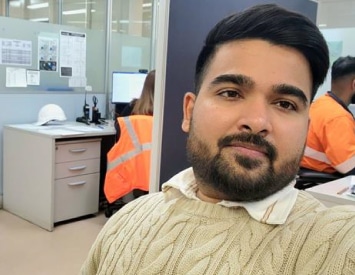
Originally from Pakistan but now based in Australia, Muhammad Sarmad chose to pursue his Master of Engineering (Electrical Systems) on-campus at EIT. His journey reflects a deep commitment to clean energy, innovation, and global engineering standards, backed by flexible, industry-driven education.
Choosing EIT for the Right Reasons
Student Boosts Future in Smart Energy Systems with EIT Degree: For Muhammad Sarmad, the decision to study at the Engineering Institute of Technology (EIT) was guided by a combination of practicality, ambition, and alignment with his career goals.
“I chose this program because it was exactly what I was looking for: low tuition fee, practical, industry-focused, and flexible,” he explains.
Having already completed a Bachelor’s degree in Cyprus and gained engineering experience, he was looking for something that could take his skills to the next level, particularly in power systems and renewable energy. “Coming from an engineering background, I wanted something that could push my skills further.”
EIT’s curriculum stood out not only for its technical relevance but also for its strong reputation. “That and their reputation stood out to me, and it just felt like the right fit,” Muhammad says, emphasizing that the course was tailored for working professionals and global engineers alike.
The Master of Engineering (Electrical Systems) offered the right blend of academic rigor and hands-on applicability, making it a strategic step for someone passionate about smart infrastructure and sustainable energy systems.
In choosing EIT, Muhammad was not just investing in a degree; he was aligning with a learning model designed for real-world impact.
Hands-On Tools That Make Impact
A key part of Muhammad’s positive learning experience was EIT’s innovative use of remote labs and software access. “Honestly, I was super impressed,” he says. “At my last educational institute, it was our responsibility to manage the licensing of different software and tools, but here, all the required tools and software were provided.”
The remote labs allowed Muhammad to gain true hands-on experience, even when off campus. “The remote labs gave me real hands-on experience, even from home,” he says, appreciating how seamless and practical the setup was.
Despite being online at times, the labs felt interactive and real. “I didn’t feel like I was missing out at all; they were smooth, interactive, and really helpful in connecting theory with practice.”
This kind of accessibility helped bridge the gap between academic learning and the technical demands of the modern workplace. It made the process of mastering complex topics like automation and smart grids far more intuitive and enjoyable.
For Muhammad, tools that work well and are easily accessible made all the difference in keeping him engaged and motivated throughout the program.
Balancing Life, Work, and Learning
Like many students, Muhammad had to juggle studies, part-time work, and personal responsibilities. “It wasn’t always easy, but I managed by setting a routine,” he shares. “I’d wake up early, focus on my studies in quiet hours, and dedicate weekends to catching up and working part-time jobs.”
He credits much of his success to the support of his family. “My family was supportive; they understood what I was working towards, and that made a big difference.”
Staying consistent was both the biggest challenge and the key to overcoming the pressures of daily life. “The biggest benefit was the flexibility and time savings,” Muhammad says. “But that also came with challenges, mainly staying consistent and avoiding distractions.”
To stay on track, he leaned heavily on structure and planning. “I relied a lot on planning daily to-do lists, calendar reminders, and setting weekly goals,” he says. “I also made sure to take breaks and not burn myself out.”
The combination of disciplined routine and support from those around him created a strong foundation for success, even during the program’s most demanding periods.
Evolving Through Global Engineering Insights
Though originally from Pakistan, Muhammad’s academic journey began in Cyprus, where he completed his undergraduate degree. “My Bachelor’s degree was from Cyprus’ University of Lefke,” he clarifies.
That experience gave him a solid technical base, but studying at EIT introduced a new dimension. “Studying at EIT pushed me to think differently, more analytically and with a broader perspective,” he explains.
The exposure to Australian standards and advanced topics in automation and smart grids helped him make critical connections between previous experience and future applications. “It helped me connect my past work with modern systems and Australian standards.”
Having worked in both Pakistan and studied in Australia, Muhammad observed notable differences between the two engineering landscapes. “There’s a clear difference in the way projects are handled,” he says. “In Australia, everything is more regulated, safety-focused, and long-term planning is key.”
These cross-cultural insights have shaped his worldview as an engineer, reinforcing his desire to be part of projects that emphasize sustainability, structure, and innovation.
Future Goals Powered by Clean Energy
With his degree completed and graduation still pending, Muhammad is focused on the road ahead. “It’s definitely given me more confidence and a clearer direction,” he says, reflecting on the personal and professional growth he’s achieved through the Master of Engineering (Electrical Systems).
His goal now is to work in energy system design and smart infrastructure, with a strong interest in clean energy. “I’m really passionate about contributing to clean energy and modern electrical systems,” he says.
The EIT experience has not just fueled his career; it has reignited his academic ambitions as well. “One day, I might even go for a Ph.D. in this field,” he adds, pointing to a future of continued learning and impact.
When asked if he would recommend EIT to others, his answer is immediate and confident. “Yes, 100%. If someone is looking for a program that’s flexible but also practical and industry-driven, EIT is a great option.”
Looking back, Muhammad is proud of the perseverance it took to complete the program. “I’m proud that I didn’t give up even when it was hard juggling work, life, and studies. It feels great to look back and see how far I’ve come.”
Are you ready to embark on a similar journey?
Contact Us