


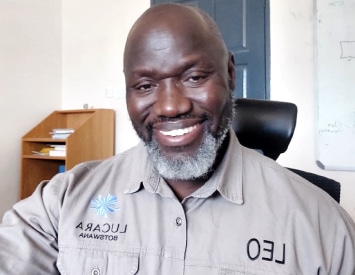
Phenyo Leokame Lekgoko, a Control and Instrumentation Technician from Botswana, recently completed the 52886WA Advanced Diploma of Industrial Automation Engineering through EIT. His journey reflects both professional resilience and a passion for continuous learning in a rapidly evolving field.
EIT Student’s Commitment to Growth and Excellence
Phenyo Leokame Lekgoko’s path into industrial automation was a natural evolution of his technical background.
As a qualified Control and Instrumentation Technician, he had already laid a strong foundation in the industry. But his drive to grow and stay current with the latest trends led him to pursue the 52886WA Advanced Diploma of Industrial Automation Engineering, which he successfully completed through the Engineering Institute of Technology (EIT) on 28 April 2025.
“I knew that as an engineering professional, EIT would afford me quality studies at the comfort of my home after my working hours,” he explained, describing his decision to study with EIT. His initial interest in online education with EIT was sparked by prior experience in networking courses offered by IDC Technologies (EIT’s sister company) in 2003.
Balancing work, study, and family responsibilities was no small feat. But for Phenyo, EIT’s online format made it all possible.
“The online setup allowed me the flexibility to study at my own pace,” he said. “Having a wife and kids meant my most effective time to study was after they had all gone to bed, which was after midnight until the early hours. The remote labs afforded me the luxury of accessing labs from all over the globe at my fingertips.”
What first drew you to the field of industrial automation engineering?
“As a qualified Control and Instrumentation Technician, I was naturally interested and drawn to Industrial Automation Engineering.”
Why did you choose to study with EIT over other institutions?
“In 2003, I did some useful networking courses offered by IDC. I guess that’s where my interest in studying with EIT stemmed from. I knew that as an engineering professional, EIT would afford me quality studies at the comfort of my home after my working hours.”
Now that you’ve completed your Advanced Diploma, how would you describe the overall experience?
“My interest in PLC programming has been revived. It felt like a complete refresher course, while also learning new things, especially in areas like telemetering and data communications.”
How did EIT’s online format and remote labs support your learning and practical understanding?
“The online setup allowed me the flexibility to study at my own pace. Having a wife and kids meant my most effective time to study was after they had all gone to bed, which was after midnight until the early hours. The remote labs afforded me the luxury of accessing labs from all over the globe at my fingertips. The labs made it easier to observe and understand principles I had learnt.”
What challenges did you face during your studies, and how did you stay motivated?
“I had challenges where my demanding work schedules at times clashed with my classes or where I failed to meet submission deadlines because of breakdowns at work or poor time management on my part. With the guidance of my LSO, I gradually learned how to manage my limited time. Our experienced lecturers were also very patient, supportive, and inspirational to say the least.”
How has this qualification impacted your role or opportunities in Botswana?
“My knowledge base has expanded, and I feel a renewed vigor. I believe I am well positioned to explore new opportunities that may present themselves with great confidence.”
Were there any specific projects or assignments that had a lasting impact on your learning?
“Yes, definitely. The assignments on Best Practice Industrial Data Communications, Hazardous Area and HAZOPs, Wireless Ethernet and TCP/IP Networking, and Radio Telemetry Systems really had a lasting impact on my learning.”
How relevant do you think industrial automation is to the future of mining or industry in Botswana?
“Industrial automation brings many benefits to the mining industry in Botswana. It helps improve mining efficiency and safety by enabling remote-controlled machinery, reducing human exposure to hazardous conditions, and maximizing overall production.
It also helps with cost competitiveness. Smart sensors and IoT devices allow for real-time monitoring of equipment and geological conditions, supporting data-driven decision-making. Automated technology can also monitor environmental impacts, ensuring more sustainable practices in accordance with ISO 14001.”
What advice would you give to someone in Botswana or the region thinking about studying engineering online with EIT?
“My advice would be to focus on time management and discipline. With those two qualities, anyone is likely to succeed. They should also remain consistent and never leave anything for the last moment.”
What’s next for you in your professional journey now that you’ve completed your Advanced Diploma?
“Since I am now more experienced in the field of instrumentation and industrial automation, I would like to put my skills to the test in Project Management and Consultancy.”
Are you ready to embark on a similar journey?
Contact Us