


Daniel Christopher Stephen grew up on a farm, but showing strong academic potential, his interests and abilities soon pointed him towards a path beyond farming.
After excelling in Mechatronics at the Queensland University of Technology and graduating with first-class honors, Daniel realized that going into industrial automation required more than academic achievement. This led him to take a more intentional path to build practical and industry-relevant skills through the Engineering Institute of Technology, where he began with a Professional Certificate of Competency in Programmable Logic Controllers (PLCs) & SCADA Systems, as well as a Professional Certificate of Competency in Allen Bradley Controllogix/Logix5000 PLC Platforms, before progressing into a Master of Engineering (Industrial Automation).
In this feature, Daniel shares his experiences, challenges, and insights from studying at EIT and building a career in industrial automation.
Tracing the Right Voltage Path
In engineering, finding the right direction often takes real industry exposure because that is where the picture starts to come together. For Daniel, this exposure made it clear that further studies at EIT were the right step to build the skills he needed. When asked about what motivated him to pursue further studies at EIT, Daniel shared: “It became very apparent to me that many engineering roles in the industry are more focused on project management, coordination, and contractor management rather than the technical work you would expect from university studies. This was the first role I found myself in as a Graduate Electrical Engineer, and it quickly highlighted the importance of building relevant skills for the position you want rather than waiting.”

Daniel’s PLC Learning at EIT
Engineering learning becomes most impactful when it is closely connected to real industry practice, where concepts are actively applied and discussed in context. When asked about his overall learning experience at EIT, Daniel answered: “My overall learning experience at EIT was fantastic. The lecturers all had active industry backgrounds, so the discussions were grounded in what is happening in industry today. In fact, the lecturers quickly proved themselves useful and capable that students from different industries would bring real engineering problems and operational issues into classroom discussions. The lecturers would actively work through those problems with the class, which created a very collaborative and practical learning environment. I also felt every course had a clear purpose and industry relevance. It did not feel like there were filler subjects included just to complete a qualification.”
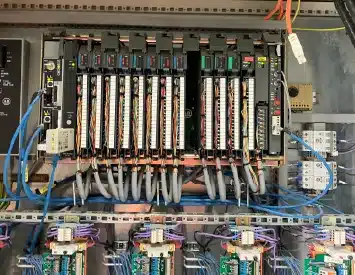
Daniel also shared EIT’s learning model that he found very valuable during his studies. “The remote labs and recorded lectures were probably the most valuable learning tools for me. Being able to access and use the software hands-on in your own time was much more beneficial and reinforced during the lectures. The remote labs gave practical exposure to the same types of systems and software used throughout industry, which helped build confidence very early on. When I first had to connect to and program PLC systems professionally, I was already comfortable with the software environment and workflows because I had already spent time using similar systems through EIT.”
Studies and 12-Hour Shifts
Balancing studies alongside long work shifts require strong discipline and resilience, especially when both commitments demand full focus and energy. For Daniel, this was a lived reality during his studies. When asked about the biggest challenge he faced, he shared: “The biggest challenge during my studies was balancing full-time work with study commitments. At the time, I was working 12-hour days at a remote mine site while also travelling several hours each week to get home to my family. Completing a master’s degree alongside that required a lot of discipline and time management. What made it achievable was the flexibility of the learning environment. Being able to access lectures remotely, complete labs in my own time, and study outside normal hours made a huge difference.”
Despite these challenges, Daniel was able to translate his studies into real-world engineering practice. “The experience and confidence I gained through EIT played a major role in helping me take on those responsibilities earlier than I expected. The knowledge I gained through the courses gave me familiarity with many of the systems, software platforms, and engineering concepts that I later encountered professionally. I genuinely believe it accelerated my career progression significantly. After only around two years in industry, I was helping lead a multi-million-dollar control system migration project, and shortly after that I moved into a senior engineering role years before others usually would.”

Leading Through a Control Systems Lens
Daniel now employs the skills he learned through EIT as a Senior Process Control Engineer at the EEHA Automation – Electrical Engineering Services. Looking ahead in his career, Daniel remains focused on advancement. “I would like to continue progressing into lead roles within industrial automation and control systems while also mentoring and supporting younger engineers entering the industry. My advice to future EIT students would be to genuinely engage with the course material rather than just aiming to complete the qualification. If you actively apply yourself and use the practical learning opportunities properly, the courses can provide an extremely strong foundation that is directly relevant to real engineering.”
Are you ready to embark on a similar journey?
Contact Us