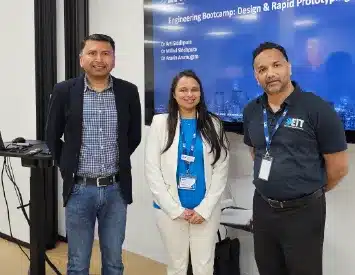
Pursuing a doctorate is a significant undertaking that involves balancing work, family, and deadlines while engaging with complex challenges. For Dr. Arti Siddhpura, a lecturer at EIT, this journey has been driven by curiosity, determination, and a passion for turning problems into practical solutions.
In this article, Dr. Arti Siddhpura shares insights on pursuing a doctorate, guiding students, and shaping the next generation of engineers. She also offers firsthand insights into the challenges, rewards, and evolving role of doctorate-level education in engineering from her personal journey to her teaching philosophy and mentoring approach.
From Curiosity to Doctorate
Many students pursue a doctorate to deepen their expertise and make a significant impact on their careers.
For Dr. Arti Siddhpura, this journey began with a fascination for understanding how things work and improving existing systems, naturally leading her to engineering. When asked what drew her to teaching at this level and how her experience shaped the way she guides her doctorate students today, she answered, “Teaching at this level is rewarding because it is not just about sharing knowledge, it is about shaping future researchers and innovators. My journey has taught me the importance of structured guidance and timely feedback. I ensure our students receive consistent support from admission through milestones, so they feel confident and prepared at every stage. Personally, balancing PhD research while raising a toddler was challenging, but it taught me invaluable time management skills. Many of our students juggle work, study, and family responsibilities, so I emphasize strategies for balance and resilience as part of my mentoring approach.”
Dr. Arti’s dedication to mentorship is strengthened by her 18 years of experience teaching Mechanical Engineering at prestigious institutions in Australia and abroad. She excels in synchronous and asynchronous teaching, grounded in adult learning principles, and has deep expertise in designing courses at both undergraduate and postgraduate levels. Throughout her career, she has navigated face-to-face, blended, and fully online learning environments. She has been with EIT since 2017 and is now a Course Coordinator and a Senior Lecturer at the School of Mechanical Engineering. In these roles, she ensures students gain not only technical knowledge, but also the guidance needed to succeed in advanced research and professional practice.
Building Scholars and Leaders
Many students wonder how doctoral teaching differs from traditional lectures and how it can shape both their research and career growth. At this level, learning focuses less on memorizing concepts and more on developing independence and professional leadership skills.
Dr. Arti Siddhpura believes that guiding students through this journey requires a holistic approach, combining academic depth with practical exposure and continuous mentorship. “I believe in a holistic approach, combining academic rigor with practical exposure and continuous mentorship.
Doctoral education is a journey, and my role is to create an environment where students can thrive intellectually and professionally. I fully acknowledge that most of our Doctor of Engineering students are mature professionals with significant industry experience, and the program is designed to be largely self-propelled. Wherever possible, I encourage students to take the lead in shaping their research direction and managing their progress. My role is to provide guidance, resources, and ensure timely feedback while respecting their autonomy and leveraging their expertise. This collaborative approach empowers students to develop confidence, independence, and leadership skills that are essential for success in advanced research and professional practice.” She also added that her own experiences as a doctoral student shaped the way she mentors today.
Dr. Arti’s scholarly journey reflects a commitment to research and innovation. Her Ph.D. project is supported by the CIEAM (CRC for Infrastructure and Engineering Asset Management) scholarship. Her interests center on condition monitoring and automation, with a focus on improving unmanned tool wear prediction.
Guidance in Every Step
Doctoral success requires consistent support and opportunities for growth beyond the classroom.
Dr. Arti Siddhpura ensures her mentorship extends far beyond teaching, but in actively shaping each student’s journey from admission to thesis defense. “My involvement goes beyond teaching Doctor of Engineering. As Research Coordinator, I oversee admissions, supervisors’ allocations, and participate in milestone reviews: candidacy, progress, and thesis defense. I also ensure students have networking opportunities through conferences and keynote sessions, which help them build professional connections and broaden their perspectives.”
For Dr. Arti, the most rewarding moments come from witnessing students grow into confident researchers and communicators. “Seeing students confidently present at the Doctor of Engineering (DEng) Conference after initial struggles is always memorable. It reflects their growth in research and communication skills, which are critical for success. Watching our students present at reputable conferences, publish in high-quality journals, and receiving accolades for their work has been the most fulfilling part of my role.”
Beyond one-on-one mentorship, Dr. Arti plays a pivotal role in shaping the broader academic experience.
Turning Hurdles into Milestones
Even the most determined doctoral students hit roadblocks especially when juggling multiple research interests or limited resources.
Dr. Arti understands this well, stating that one of the biggest challenges in mentoring doctoral students is balancing diverse research interests with available resources. “I address this by carefully matching students with supervisors and fostering a collaborative environment where they can access expertise beyond their immediate team. Building a strong support system is key to overcoming these challenges.”
Her guidance doesn’t stop at individual mentorship. Dr. Arti’s leadership extends to coordinating the On-Campus Bachelor of Science (Mechanical Engineering), Graduate Certificate in Safety, Risk and Reliability Engineering (GCSR), and serving as deputy coordinator for Doctor of Engineering (DEng) courses, ensuring the smooth delivery of academic programs and supporting students at every level.
Strategies for Doctoral Success
Pursuing a doctorate can be overwhelming, with paths that aren’t always clear.
Dr. Arti highlights that finding the right research topic is everything. “Pick a topic that genuinely interests you. Students should propose a unique research focus, which differs from traditional PhD expectations. Take the time to find something that matches your passion and strengths.”
She also reminds students to stay curious, resilient, and open in communication. “A doctorate is a marathon, not a sprint, and challenges are part of the process. Ups and downs are normal, so enjoy the journey for it’s more important than the destination. Connect with fellow researchers and build a support network to help you through the tough spots.”
With her extensive experience and scholarly prowess, Dr. Arti is shaping the future of Mechanical Engineering education and research, leaving an indelible mark on both her students and the academic community at large.
Expertise That Shapes Research
Doctorate-level education in engineering is rapidly evolving, requiring more than just technical know-how to stay ahead.
Dr. Arti emphasizes that future students must embrace interdisciplinary research, industry collaboration, and technology-driven learning. “Doctoral candidates today need strong problem-solving skills, adaptability, and the ability to communicate complex ideas effectively. With the rapid evolution of AI and Machine Learning, understanding these technologies is crucial as they transform industries,” she explains.
She also points out that modern doctoral students are expected to possess deep expertise in their fields while collaborating across disciplines, preparing them for diverse career paths beyond academia. “Employers value transferable skills such as communication, project management, and adaptability—qualities that help graduates thrive in a world where engineering and technology are constantly reshaping industries.”
With her commitment to guiding students, Dr. Arti continues to fuel the next generation of researchers. Her work exemplifies the power of advanced research to shape innovators who will define the future of engineering.
This article was published March 3rd, 2026 and the content is current as at the date of publication.