


What does it take to juggle a global engineering career while studying? EIT student ambassador Hanane Oudli shares how she balanced remote work, academic deadlines, and family life … all while driving innovation in power systems and renewable energy across continents.
In an age where engineering challenges transcend borders, many students are learning to do the same.
The traditional model of full-time study followed by full-time work is being redefined, especially for learners at the Engineering Institute of Technology (EIT), where online, industry-focused programs enable students to study from anywhere, and work everywhere.
One standout example is Hanane Oudli: an Electrical Engineer, Lecturer, LinkedIn Top Voice, and passionate EIT Student Ambassador.
Originally from Morocco, with roots in Canada and currently based in Brunei, Hanane has become a powerful advocate for global mobility, academic resilience, and career-driven education.
While completing her Bachelor of Science (Electrical Engineering) at EIT in 2024, Hanane worked remotely as a professional engineer, balancing a demanding job in power systems with her academic studies, and proving that meaningful professional development doesn’t need to wait until graduation.
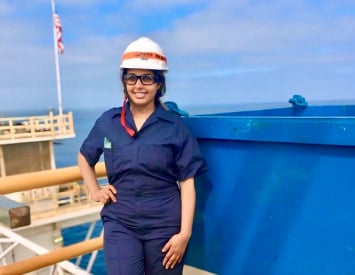
Gaining Industry Experience While Studying
Rather than viewing work and study as separate life stages, Hanane embraced a model where both could reinforce each other.
During her undergraduate program at EIT, she took on a remote role as an Electrical Engineer, focusing on power system protection within transmission networks and contributing to on-grid solar system design and research.
“It was more than just a job, it was a lab extension,” Hanane says. “I was learning in the classroom and then applying that knowledge almost instantly in the real world. That kind of synergy is rare, and incredibly powerful.”
Her work required her to apply traditional power engineering principles to modern challenges in renewable energy, including optimizing solar system efficiency, an experience that enriched her academic understanding and boosted her confidence as an engineer.
This kind of dual exposure to theory and practice is a hallmark of EIT’s applied learning model, where real-world relevance is built into every course.
Managing Time, Energy, and Expectations
Working remotely while completing an engineering degree is no small feat. For Hanane, it required a disciplined yet flexible routine that allowed her to meet academic and professional goals without compromising her wellbeing.
“I began each week by planning my schedule in detail, outlining academic deadlines, work tasks, and even personal responsibilities. It wasn’t just about time management; it was about energy management.”
She adopted a digital productivity system using Trello to manage projects, Google Calendar to create dedicated study and work blocks, and Notion to track reading lists, assignment deadlines, and progress toward goals. Regular weekly reviews helped her stay on track and make informed adjustments.
“The key was to break big tasks into small, manageable chunks and set realistic, focused time blocks. That helped me avoid overwhelm and feel in control, even during high-pressure weeks.”
This structure allowed her to maintain momentum in both spheres, and still make space for family and personal responsibilities, another layer of complexity that she acknowledges with honesty and pride.
“It wasn’t always smooth. But learning to prioritize and protect my time helped me grow not just as an engineer, but as a person.”
Navigating Conflicts and Pressure: When Deadlines Collide
Even with the best planning, conflict is inevitable, especially during exam periods or when academic and professional peaks overlap. For Hanane, the solution was clear communication and proactive problem-solving.
“Whenever I knew an intense academic period was approaching, I communicated with my supervisor in advance. That transparency allowed me to manage expectations and often shift work deadlines slightly to create room for study.”
She also used strategic planning techniques, such as front-loading work tasks ahead of academic deadlines, and identifying which tasks had the highest urgency or impact at any given time.
“Sometimes I’d finish my work projects early so I could fully dedicate myself to preparing for exams or completing my final-year capstone. It was about playing the long game.”
This level of professional maturity (prioritizing, planning, and openly negotiating commitments) is a critical skill in the real-world workplace, and Hanane developed it while still a student.
“These were lessons in adaptability, leadership, and self-advocacy. EIT’s flexible learning format gave me the space to make those decisions for myself.”
Rethinking Remote: Growth Beyond the Office
While remote work has gained mainstream acceptance in recent years, it still comes with myths, like the idea that career development suffers outside of a traditional office setting. Hanane is quick to challenge that notion.
“Working remotely didn’t limit my growth, it refined it,” she explains. “I had to become more self-directed, more organized, and much more intentional with communication.”
In the absence of physical office dynamics, Hanane focused on building strong virtual relationships, asking questions, and actively contributing to her team’s goals across time zones. She also developed vital skills in virtual collaboration, project ownership, and digital communication.

“Remote work helped me build confidence in my ability to lead and contribute meaningfully, even when I wasn’t in the room. That’s the reality of global engineering today.”
Far from isolating, remote work expanded her horizons, enabling her to collaborate on high-impact projects and tap into international conversations about energy, sustainability, and systems innovation.
Purpose, Resilience, and the Power of Flexibility
For Hanane, the experience of working and studying simultaneously wasn’t just a logistical challenge, it was a transformative journey that touched every part of her life.
“It wasn’t just about managing tasks. I was also managing family responsibilities and navigating big life transitions,” she shares. “What I learned most was resilience: how to lead with purpose and stay focused on what truly matters.”
She credits EIT’s flexible, globally accessible, and accredited programs enabling her to pursue both academic excellence and career momentum. The institute’s structure allowed her to keep moving forward, even when life got complicated.
“EIT gave me the tools, but also the freedom to build my own path. That made all the difference.”
Today, as she continues her Master of Engineering (Electrical Systems) and advocates for women in STEM globally, Hanane stands as a powerful example of what’s possible when education meets flexibility, and ambition meets real-world opportunity.
“To any student who’s wondering whether they can work and study at the same time – yes, you can. With the right systems, support, and mindset, you’ll not only keep up, you’ll thrive.”
A New Blueprint for Engineering Education
Hanane Oudli’s story is a testament to the evolving nature of engineering education, and the increasing importance of flexible, globally relevant learning environments.
Her goals are as ambitious as they are inspiring. She plans to obtain licensure as a Professional Engineer, complete a Doctor of Engineering, and establish an engineering consulting firm specializing in system optimization and sustainable power solutions.
As industries continue to digitize and decentralize, the ability to study from anywhere, work remotely, and adapt quickly isn’t just convenient, it’s essential.
EIT’s commitment to combining academic rigor with real-world application, and its support for students navigating diverse professional and personal circumstances, is equipping engineers like Hanane to succeed – not just in classrooms or offices, but on a global stage.
Wherever you’re studying from, the future of engineering isn’t limited by geography. And thanks to pioneers like Hanane, it’s being built by students who dare to learn and lead, all at once.