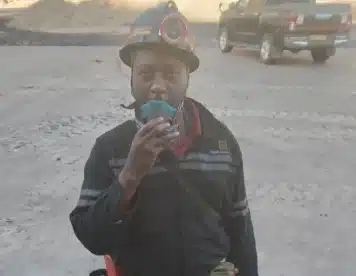
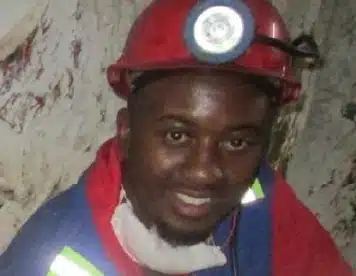
Learning often begins in unexpected ways, and for Nhlanhla Ncube, a conversation during a period of uncertainty became the starting point of a new learning journey in engineering. What followed was a gradual process of exploring new areas of study while building on his existing professional experience.
This article features Nhlanhla’s journey in engineering and occupational safety, highlighting how he has developed his skills through online learning with EIT’s 52857WA Advanced Diploma of Plant Engineering, while continuing to work in a demanding professional environment.
An Unexpected Introduction
Career paths are often shaped by moments that are not planned. For Nhlanhla, that moment came through a chance conversation with a former colleague, which introduced him to the idea of further study. “This was at a time in my life when I was unemployed and searching for purpose, and my days were largely unoccupied. That conversation sparked a fire in me, and within the next month, I had worked out a budget. I contacted EIT to find out more about the courses that aligned with my previous experience and knowledge. I had recently completed a diploma in mine ventilation which included modules in thermodynamics, compressors, fans, blowers, heating and cooling, and safety.”
Turning Toward Learning
Nhlanhla reflected on the practical considerations that would support his decision to pursue further learning. “During 2020 and the Covid-19 lockdown, my college, Zimbabwe School of Mines, introduced online learning. This was my first introduction to virtual classrooms, but simply replicating the traditional classroom experience using an online platform left a sour taste in my mouth. After attending EIT’s introductory webinar, however, I quickly realized that EIT was going to be different, and now that I’ve completed the course, I could not be happier with the experience.” The practical design of the program itself also played an important role in Nhlanhla’s study journey. “Further motivation was the flexibility EIT allowed; both in the learning methodology and because my tuition fees could be paid in monthly increments. All these factors gave me confidence that pursuing an advanced diploma with EIT would be the right choice.”
Plugged Into Practice
Building on his earlier decision, Nhlanhla’s EIT experience quickly moved into the realities of applying theory to practice. “Overall, I found most of the modules challenging in a way that required me to stretch myself; I developed a newfound appreciation for various industrial processes that I had taken for granted. I also enjoyed the exposure to a range of engineering software. Most of them were new to me; I had to spend considerable time researching or practicing on demo versions of the software, but I found that EIT has more than enough resources in its library to help students master the software.”
That learning experience was reinforced through consistent use of EIT’s practical learning environment. “I enjoyed the remote labs experience often spending my free time there to familiarize myself with the software I was intending to use for assignments. The virtual labs are built for ease of use. Especially for a first-time user like me.”
Power Cuts and Technical Progress
Nhlanhla also had to navigate practical challenges outside the academic environment that tested his ability to stay consistent and adaptable while learning online. “My biggest challenge was overcoming my environmental constraints. Especially those elements outside of my control. We have frequent power cuts and unstable internet connections; it meant that at times I could not attend the live webinars. I was, however, able to review webinar recordings which helped me complete the assignments. I have a special appreciation for EIT who have taken into consideration the different environments we have in different parts of the world – ensuring we have ways of completing the qualifications.”
Despite these constraints, Nhlanhla’s studies also strengthened his understanding of how engineering systems operate in real industrial environments. “Most relevant to my field of experience is the better understanding of the interconnected nature of various devices and equipment in an industrial setting. Especially how relevant functionality and efficiency are to well-run operations. The specific skills I gained are skills in safety management, machine maintenance, and technical communication. These skills will be invaluable in what is only the start of my journey.”
Igniting New Horizons
As Nhlanhla looks ahead in his career, he continues to explore how his developing skills can be applied while also considering future opportunities in specialized areas of engineering. “In the future I hope to enter the mine ventilation industry, although I am currently in occupational health and safety.” In his current role, Nhlanhla is already beginning to see how his expanded technical understanding can be applied in practice within the mining environment. “Currently I am employed as a safety officer at a coal mine in Hwange, Zimbabwe. So, while there is no specific assignment, project, or task that has been very relevant. I do feel very appreciative to have my advanced knowledge of industrial machinery and more insight into mechanical processes. For example, I have been able to appreciate the licensing process for pressure vessels, and I have been able to identify more hazards, including the risks from hydraulic systems.”
Looking beyond his present role, Nhlanhla is also considering further development through continued study and long-term growth in the field of industrial safety and engineering. “My long-term career aspiration is to become an educator in an institution that values sharing educational knowledge over passing grades. I aim to change the lives of those I interact with and to help them change other people’s lives.”
This article was published July 15th, 2026 and the content is current as at the date of publication.