From ancient Olympic fires to billion-dollar lighting systems, sports field lighting has come a long way. As Australia gears up for the 2032 Games, engineers have never been more vital. Don’t miss the illuminating upcoming EIT webinar that explains why.
From Torches to Tech Triumphs
When the ancient Greeks first staged the Olympic Games around 776 BC, the concept of playing under artificial light was unthinkable. Sports were dictated by the sun, and the stars if night fell too soon. Athletes trained and competed during daylight hours, their movements illuminated by nature alone.
Fast forward to the late 19th and early 20th centuries, when artificial lighting began to change how and when we played. In 1878, a pair of football clubs in England trialed electric lighting in a match; sparking, quite literally, the start of night games. The technology was crude, the lighting uneven, and the visibility questionable, but the potential was clear.
By the mid-20th century, innovations in floodlighting and power distribution meant professional sports could finally shine after dark. Major sporting venues, including those hosting Olympic events, began to incorporate powerful lighting rigs to ensure consistent play and better broadcast quality.
Sports field lighting quickly became more than functional. It evolved into an art form: balancing brightness, uniformity, color temperature, and glare control. And behind every leap in lighting stood an engineer, equipped with a slide rule, circuit diagram, or CAD file.
Today, sports lighting is critical not just for performance, but for safety, sustainability, and spectacle. And the story is still unfolding.
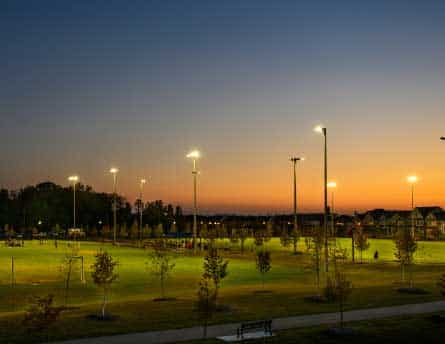
The Modern Olympic Glow-Up
The Olympic Games are no longer just global sports events; they are theatre, television, and testaments to technology. Lighting plays a central role in setting the stage for billions of viewers around the world.
From Sydney 2000 to Tokyo 2020, Olympic venues have dazzled with their lighting innovations. The Beijing 2008 Bird’s Nest stadium featured more than 4,000 LED fixtures, with lighting controlled by AI-based systems to create mood shifts and dramatic effects during ceremonies.
In recent Games, lighting standards have evolved to meet not just the needs of athletes, but also those of broadcasters. Uniform lighting levels prevent shadows and ensure camera clarity from every angle. LED technology, paired with smart control systems, has significantly reduced power consumption while increasing flexibility and responsiveness.
Engineers must also consider environmental concerns: light spill into surrounding communities, wildlife disruption, and energy efficiency. The answer lies in advanced lensing, dimmable solutions, and precise modelling software that allows designers to simulate and perfect lighting plans before a single fitting is installed.
It is a high-tech dance of lumens and logic, choreographed by professionals who understand both the beauty and the science of light.
Brisbane 2032: A Bright Engineering Opportunity
Australia is once again preparing to step into the Olympic spotlight with Brisbane 2032. For engineers across the country, this is not just another event; it is a once-in-a-generation opportunity to build smarter, greener, and more spectacular sports infrastructure.
With 37 venues planned across Southeast Queensland, sports field lighting is a massive focus area. Engineers will be challenged to meet AS 2560 standards while navigating sustainability goals, budget constraints, and the expectations of global broadcasters and fans.
Unlike previous Games, Brisbane 2032 is expected to be climate positive. Lighting design must go beyond efficiency; it must actively contribute to reducing carbon output. This involves incorporating renewable energy, daylight sensors, battery backups, and adaptive lighting schedules based on real-time demand.
For electrical and electronic engineers, this is a playground of innovation. They will need to collaborate across disciplines, working with architects, environmental consultants, and city planners to deliver lighting that serves sport, audience, and the planet.
Lighting engineers are not just supporting the Games; they are helping to define its legacy.
Why Engineers Own the Spotlight
Field lighting is no longer the domain of contractors or manufacturers alone; it is a complex discipline led by electrical and electronic engineers trained in high-level design and standards compliance.
Underpinning much of Australia’s sports lighting is AS 2560, the Australian Standard that outlines performance, safety, and operational guidelines. Understanding this standard is essential for ensuring compliant and effective lighting across sporting codes, whether it is a local footy field or an Olympic stadium.
But the standard is only a foundation. Engineers must apply deep knowledge of photometrics, electrical distribution, heat management, and intelligent control systems. They must also consider ongoing maintenance, integration with smart infrastructure, and compatibility with emergency lighting systems.
In short, it is not just about brightness; it is about brilliance; the kind that only trained engineers can deliver.
As we look to 2032, Australia needs a new generation of electrical professionals fluent in these systems. These are the individuals who can innovate, model, and deliver lighting that meets the needs of players, fans, and the future.
Don’t Miss the EIT Webinar
All of this, and more, will be unpacked in EIT’s upcoming webinar, “Welcome to Sports Field Lighting (AS 2560),” taking place on 8 October 2025, from 4:00 AM to 5:00 AM UTC (6:00 AM South Africa Standard Time).
Presented by Alexandra Gregory, Senior EIT Lecturer and Principal Electrical Engineer at AECOM, the webinar is a must-attend for anyone interested in lighting design, engineering innovation, or the future of Olympic infrastructure. With real-world insights from a leading practitioner, attendees will gain a practical understanding of how world-class lighting systems are conceived, designed, and delivered.
Attendees will explore:
- The core principles of lighting under AS 2560
- Key design considerations for different sports and venues
- How Australia’s upcoming Olympic spotlight will shape the lighting industry
- Tools and techniques for compliant, efficient design
- The evolving role of engineers in sports infrastructure
Whether you are already in the field or considering upskilling, this session could be your first step toward illuminating the future.
Registration is now open. Attendees will receive a recording of the webinar, and those who request it will be issued a certificate of attendance.
References
The History of Stadium Lighting
This article was published August 29th, 2025 and the content is current as at the date of publication.
Back to news