HomeNewsAgriculture Automation Is A New Engineering Frontier
Agriculture Automation Is A New Engineering Frontier
Population growth, global warming, and the advancement of technology have meant that Agriculture Automation is a needed and positive response to traditional agriculture.
Artificial Intelligence (AI) allows for better monitoring of global crops and all-important data on what is available in terms of food resources and vital resources for the world, like water management.
Agricultural automation has been an ever-growing industry for decades and now includes a broader range of tasks, including irrigation, planting, and even flower pollination.
According to the paper North America, Japan, and Europe were leading agricultural mechanization.
The lead is due to focus on agricultural mechanization and environmental management. Inputs required for the development of agricultural mechanization include bio-chemical, socio-economic, and engineering factors that are an integral part of agricultural development.
Engineers and farmers are working together to create technological solutions, and smart farms are becoming the norm.
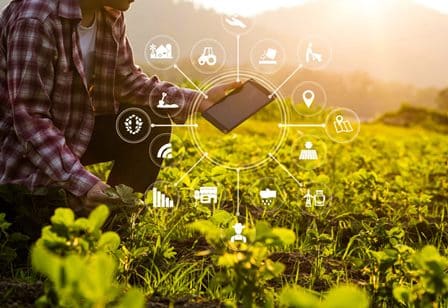
In the simplest terms, smart farms allow the agriculture sector to have control over precision agriculture.
Advanced technologies are used in such a way that production is at its most efficient, allowing farming practices to cut waste, and have reasonable insight into production yields but also there is an upside to reducing heavy labor and removing tedious tasks in the farming process.
The paper Recent Advances in Smart Farming takes a look at how engineers have been able to grow the industry and create an agriculture sector that is incredibly advanced and more sustainable.
Instance Segmentation with Mask R-CNN Applied to Loose-Housed Dairy Cows in a Multi-Camera Setting: The system proposes surveillance cameras that record cows at dairy farms and aims to automate cattle herd activities. The system uses Convolutional Neural Networks to reflect the performance model.
Machine Learning-Based Microclimate Model for Indoor Air Temperature and Relative Humidity Prediction in a Swine Building: Machine-learning models have used air temperature and humidity in swine buildings that are able to optimize feeding selections.
Design of Scalable IoT Architecture Based on AWS for Smart Livestock: Scalable cloud-based architecture targets livestock and environmental monitoring in terms of health, growth, emotional state, stress and reproduction.
SheepIT, an E-Shepherd System for Weed Control in Vineyards: Experimental Results and lessons learned: Experimental results collected behaviour-related data to assess the welfare of sheep.
Calf Birth Weight Predicted Remotely Using Automated in-Paddock Weighing Technology: Predictive models of calf birth weight from live weight data collected remotely.
A Novel Miniaturized Biosensor for Monitoring Atlantic Salmon Swimming Activity and Respiratory Frequency: A miniature biosensor monitors individual swimming activity and the metabolic condition of Atlantic salmon in land-based aquaculture systems.
This new research shows how helpful automation is in a variety of agriculture, and how system engineering allows farmers to understand every part of their farming activities.
Under the moniker of smart farming other essential aspects of agriculture is also of vital importance.
Data have demonstrated the poor use of water resources in agriculture. To utilize it better IoT is used to look at weather patterns, and effectively use rainwater.
One of the solutions for individual farming is self-contained agricultural precision systems based on central pivot irrigation systems.
The technology uses an underground sensor network that monitors humidity and temperature which can configure a number of factors in soil.
IoT can also monitor the weather to ensure crop survival by raising risks like pests and weather conditions.
Agricultural robots aren’t new, but they are new in terms of how they are used in conjunction with The Internet of Things.
Modern agricultural mechanization and robot technology with automation include a number of robots that assist in smart farming.
These include cultivation robots, fertilizing robots, weeding robots, vegetable grafting robots, transplanting robots, harvesting robots, picking robots and seedling robots, trees pruning robots and fruit picking robots. But they are not limited to manual labor robots.
Drone technology for instance has also shown to be valuable when it comes to planting.
2. Automatic control of a facility or farm:
This can be applied in most facets of agriculture. From soilless cultivation, temperature regulation and photosynthesis of plants can be analysed through control. Monitoring is also completely plausible in terms of plant agriculture for growth purposes.
Automation control gives good insight into irrigation and can also optimize and manage it with less error. Automation in harvesting is also important as it not only improves harvest time (think of time-sensitive crops) but also improves efficiency.
There’s also room for data to show harvest, compare it with other annual harvests and even the potential to have the quality of harvest assessed.
The application of IOT technology includes agricultural Internet information perception and recognition technology and self-organizing network deployment and information transmission technology for agriculture.
Sensors and signals will be valuable equipment to reach complete IoT integration in agriculture – and it is very possible to do it.
Even novice farmers can utilize IoT sufficiently to create small-scale smart farms.
Smart Farms in practice
Last year we reported on EIT’s Senior Developer Mark Cupitt’s own farm where IoT has been exceptionally helpful.
Solar-charged devices and the internet allows Mark great control over his stretch of land.
Smart Farms are at its core meant to be simple, just in a very digitized way.
A laid-back lifestyle on a farm in the Philippines is not only ideal, but simpler than you may think due to the Internet of Things (IoT). At its most basic level, IoT connects electronics and everyday objects to a wider infrastructure that allows those devices to intelligently interact with the…
The paper e-Assistance for Smart Farmers proposes that there are still four key areas for Smart Farms, regardless of scale, to sow its rewards.
Hardware
Cheaper and more accessible sensors that are to be attached to devices for actuation and monitoring are needed. Sensors can be costly, but they also need to be well-chosen based on the data that is needed. Since these technologies are being developed it’s still not as easy as picking sensors for a specific crop or climate.
Analytics
High-tech agriculture is dependent on data analytics, and data collection needs to be done locally or through cloud data. This is where mined data comes in to make the right predictions for successful farming practices.
Maintenance
Hardware maintenance is still a challenge as many sensors are exposed to natural elements for long periods of time. Maintenance is still crucial for existing sensors, but in the future maintenance should come down.
Mobile data
Smartphones and devices are essential for smart farming. Farmers need to be able to wirelessly connect with their farms and get all the data they need.
As these matters are being advanced, it’s important to take note of how agricultural jobs might change. For instance, hardware maintenance could replace some of the jobs that might be automated, showing that although automation and smart farming will rely more on systems like robots for labour, human jobs are still important for the successful running of smart farms.
In the same way, data analysts for farms will be needed to create better algorithms for specific farming scenarios, crop cultivation or livestock management.
In the pressured environment of global population increases and the need for sustainability, Smart Farms are needed in the agriculture arena.
These farms ensure better control over the internal processes and lower production risks. This in turn means the sector is better equipped for investors and the economy to place faith in crops. Production output can be foreseen and areas like distribution can for instance be pre-managed or planned.
This also guarantees better product distribution. There is major cost reduction and also waste reduction in smart farming. There is a reduction in risks. Pest control can be managed on simpler terms. Most of all there is an increase in business efficiency.
Agricultural engineering technology is a comprehensive technology that covers multi-disciplinary fields including mechanical engineering, agricultural planting technology, agricultural machinery technology, engineering management technology, genetic engineering technology, and agricultural product processing technology.
Civil and structural engineering as well as automation is part of the group of potential engineers that forms part of this major field of agricultural engineering.
For scope, current engineers or students interested in any of the following will find a home in agriculture.
Design of agricultural machinery, equipment, and structures
Machine testing of new equipment
Protecting surface and groundwater quality
Developing and managing bioprocessing systems
Environmental control systems
Energy conservation
Soil and water conservation
Biofuel production and utilization on farms
Post-harvest processing
Precision farming technologies
Farm operations and management, designing off-road vehicles and agricultural equipment
Natural resources management
Because agriculture is the backbone of almost any nation in the world there are a lot of opportunities in terms of employment but also in terms of programs that develop these skills in engineers.
One thing is certain engineers have a role to play in agriculture, and smart farms and automation are just the start.
References:
Ren, Dong & Martynenko, Alex. (2018). Guest editorial: Robotics and automation in agriculture. International Journal of Robotics and Automation. 33. 10.2316/Journal.206.2018.3.206-0001.
Career in agricultural engineering: A prologue. Available from: https://www.researchgate.net/publication/319397804_Career_in_agricultural_engineering_A_prologue [accessed May 09 2022].
Research on the Application of Agricultural Engineering Technology in Agricultural Modernization. Available from: https://www.researchgate.net/publication/347350694_Research_on_the_Application_of_Agricultural_Engineering_Technology_in_Agricultural_Modernization [accessed May 09 2022].
E -ASSISTANCE FOR SMART FARMING. Available from: https://www.researchgate.net/publication/359730179_E_-ASSISTANCE_FOR_SMART_FARMING [accessed May 09 2022].
Guest editorial: Robotics and automation in agriculture. Available from: https://www.researchgate.net/publication/325307706_Guest_editorial_Robotics_and_automation_in_agriculture [accessed May 09 2022].
Application of IoT and Cloud Computing in Automation of Agriculture Irrigation. Available from: https://www.researchgate.net/publication/357919561_Application_of_IoT_and_Cloud_Computing_in_Automation_of_Agriculture_Irrigation [accessed May 09 2022].
This article was published May 13th, 2022 and the content is current as at the date of publication.