




Course Overview
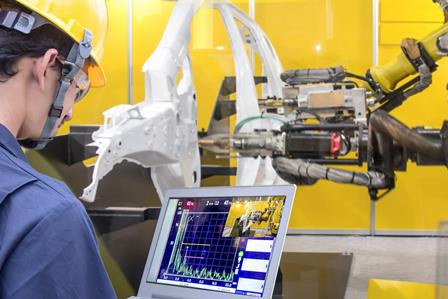
Industrial Automation Engineering is an expanding stream of engineering with an increasingly profound influence across modern industries and enterprises. As industrial processes continue to evolve through rapidly advancing technologies, previously mechanized systems that required human intervention are now increasingly operated through computerized control systems for improved accuracy, precision, efficiency, and cost-effectiveness.
This practical qualification is designed to prepare you with job-ready skills as an industrial automation engineering technologist across industries such as manufacturing, power generation, mechatronics, mechanical, mining, and chemical engineering. Throughout the program, you will develop knowledge and practical skills in instrumentation, process control, and industrial automation technologies that are highly valued in today’s evolving industrial workplace.
Graduates of this program will be able to:
- Apply principles of physics, electrical engineering, automation, circuit theory, control, and instrumentation, to analyze and model industrial systems using established technologies and standards.
- Integrate mathematics, numerical analysis, and computer science to solve problems within the industrial automation discipline.
- Demonstrate expertise and professional judgement in industrial automation engineering design practice, incorporating contextual factors such as safety, sustainability, cost, societal needs and compliance with international and local regulatory requirements.

This course is internationally recognized under the Sydney Accord.



Program Details
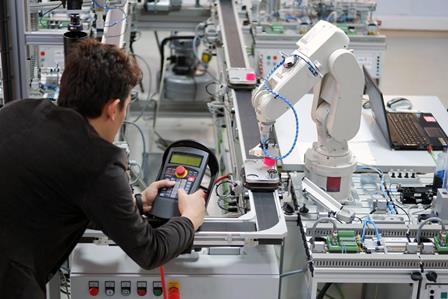
The Bachelor of Science (Industrial Automation Engineering) prepares you for the fast-growing world of smart technologies and automated industries. You will develop practical skills in engineering mathematics, programming, instrumentation, control systems, PLCs, SCADA, embedded systems, industrial communications, AI, robotics, and cyber security. The program combines technical theory with hands-on workshops, industrial experience, and a final-year capstone project to help you apply your knowledge in real engineering environments. Designed to build industry-ready graduates, this qualification equips you with the skills needed for careers across manufacturing, mining, energy, utilities, and advanced automation industries.
The degree consists of a combination of common units, sub-discipline specific ‘stream’ units, industrial work experience, and a final year project. The program duration is three years full-time. We deliver units over two semesters per year, and you will take 4+5 units per semester. There will be a short mid-semester break and extended breaks between semesters.
Please refer to the current teach-out program structure here.
Note: units may be completed in a different order depending on individual circumstances, pre-requisites and unit availability.
Year One
| Unit Code | Subjects | Credit Points |
| BSC101 | Engineering Mathematics 1 | 3 |
| BSC102 | Electrical Circuit Theory and Analysis | 3 |
| BSC103 | Engineering Physics and Materials | 3 |
| BSC104 | Engineering Drawing and CAD | 3 |
| BSC105 | Engineering Ethics and Professional Practice | 3 |
| BSC106 | Engineering Mathematics 2 | 3 |
| BSC107 | Engineering Programming | 3 |
| BSC111 | Industrial Instrumentation and Control | 3 |
| BIA109 | Principles of Chemical and Process Engineering | 3 |
Year Two
| Unit Code | Subjects | Credit Points |
| BSC201 | Engineering Management | 3 |
| BSC202 | Engineering Mathematics 3 | 3 |
| BIA203 | Ancillary Support Systems | 3 |
| BSC206 | Communications and Networks | 3 |
| BIA205 | Introduction to Programmable Logic Controllers | 3 |
| BIA206 | Data Analytics and Artificial Intelligence | 3 |
| BIA207 | Modern Industrial Communication Systems and Protocols | 3 |
| BIA208 | Embedded Systems Design | 3 |
| BSC209 | Analysis and Modelling of Industrial Control Systems | 3 |
Year Three
| Unit Code | Subjects | Credit Points |
| BIA301 | Supervisory Control and Data Acquisition Systems | 3 |
| BIA302 | Lifecycle of an Industrial Automation Project | 3 |
| BIA303 | Safety Systems Engineering | 3 |
| TBA | Elective-1* | 3 |
| TBA | Elective-2* | 3 |
| BSC305 | Technology, Sustainability and Society | 3 |
| BSC307 | Engineering Capstone Project (Industrial Automation Engineering) | 9 |
Additional Mandatory Units
| Unit Code | Subjects | Credit Points |
| Hands-on Workshop 1 | 0 | |
| BXX001-004 | Hands-on Workshop 2 | 0 |
| Hands-on Workshop 3 | 0 | |
| Hands-on Workshop 4 | 0 | |
| BSC210 | Industrial Experience | 0 |
List of Electives* (2 Electives to be selected)
| Unit Code | Subjects | Credit Points |
| BIA306 | Power Electronics and Industrial Drives | 3 |
| BIA307 | IT/OT Cyber Security | 3 |
| BIA308 | Industrial Robotics and Mechatronics | 3 |
| BEE212 | Signal Processing | 3 |
| BEE309 | Big Data Analytics in Electricity Grids | 3 |
Work-Integrated Learning
EIT’s Bachelor of Science programs require students to undertake 240 hours of paid or unpaid professional work-integrated learning. This can incorporate paid or unpaid internships, site visits, contributing to industry projects, and networking activities.
In undertaking an internship, students will interact with employees and become exposed to organizational policy and culture. You will familiarize yourself with organizational communication procedures, a variety of engineering disciplines, and obtain insight and practical aptitude in projects from the planning phase to completion.
If you already have some work experience in the relevant engineering field, you may apply to have credit granted by completing the associated recognition of prior learning form.
Bachelor of Science (Industrial Automation Engineering) – Mapping of Program Learning Outcomes with Graduate Attributes and Engineers Australia Stage 1 Competencies for Engineering Technologists.
Entry is available to applicants who hold one of the following:
1. Year 12: Australian Senior Certificate of Education (or equivalent), completed within the past 3 years, with a minimum score of 60% in Maths;
- Applicants who have completed Yr 12 (or equivalent) more than 3 years ago will also need to demonstrate relevant work experience in the field of study applied for.
2. A relevant (to the sub-discipline) Engineering AQF Diploma or higher or a relevant (to the sub-discipline) overseas qualification equivalent to an Engineering AQF Diploma or higher which was completed within the last 10 years with successful completion of all Maths units/modules + recent industry work experience in a relevant field.
English Language Proficiency Requirements:
Entry to this course requires demonstration of English language proficiency at the level of an IELTS overall score of at least 6.0 (with no individual band score less than 5.5)
The methods of satisfying this English language proficiency requirements are generally through (but not limited to):
- An Australian Senior Certificate of Education or equivalent.
- A specified level of achievement in a recognised English language test, such as IELTS (or equivalent).
- Satisfactory completion of another tertiary course offered in English.
- Work history in an organization where English is the language of communication.
NOTE: All CRICOS applicants from non-English speaking countries (as determined by the Australian Department of Home Affairs) are required to provide results from a recognised language test such as IELTS or equivalent.
NOTE: All applications will be assessed on a case-by-case basis.
For full current fees in your country go to the drop down filter at the top of this page or visit the Fees page.
Payment Methods
Learn more about payment methods, including payment terms & conditions and additional non-tuition fees.
Like all Australian higher education providers and universities, EIT programs are accredited by the exacting standards of the Australian Government’s Tertiary Education Quality and Standards Agency (TEQSA).
This on-campus bachelor’s degree (Perth Campus only) is fully accredited by Engineers Australia under the Sydney Accord. It is internationally recognized through the International Engineering Alliance (IEA) and its signatory countries, ensuring global recognition of the qualification and alignment with international engineering education standards.
You can find the accreditation here.
Find out more about country-specific accreditation and professional recognition.
This course is classified as Level 7 under the Australian Qualifications Framework (AQF).
This course may use the following software:
- Desmos online calculator
-
National Instruments ELVISmx Instrument Launcher (on Remote Lab)
- National Instruments Multisim (on Remote Lab)
-
Autodesk Inventor
-
AutoCAD
-
MATLAB
-
Python 3.10
-
CodeBlocks C/C++ IDE
-
Repl.it (Cloud IDE)
- SIMULINK
- UniSim Design by Honeywell
-
Python Jupyter Notebook
-
Google Colab
-
Codesys
-
RSLogix 5000
-
Pytorch
-
KNIME
-
Apache Mahout
-
Keil μVision V4 and V5
-
STM32CubeMX
-
STM32CubeIDE
-
Proteus
- SCILAB
-
PlantSCADA
-
Exostructure
-
Citect SCADA
-
PlantSCADA
- OSHA’s Hazard Identification Training Tool
-
PowerFactory
-
LabView
-
ANSYS
-
SolidWorks
-
Inventor
- PSIM
- WEKA
- R
Due to ongoing unit and course reviews, software may change from the list provided. Learn more about the Practical Learning at EIT here
Graduates will be employable as technologists working in a wide range of manufacturing, industrial, chemical, military, electrical, mineral processes, and mining industries.
Potential job roles include engineering and management positions in the following areas of expertise:
- Process control, commissioning and production management
- Plant, factory and building automation
- Programmable Logic Controllers (PLCs), Distributed Control Systems (DCSs) and SCADA
- Industrial design and consultation
- Supply chain management, quality assurance, and sales
- Operations, maintenance, field services, and technical support
- Controls, instrumentation, and robotics
Our bachelor’s degrees take three years to complete full-time, and longer for those studying part-time. You will spend approximately 10 hours per week, per unit, learning the program material, completing assessments and attending tutorials. After enrolment the maximum time allowed to complete all units is 8 years.
Applications are open for our upcoming intake. You must submit your application at least four weeks before the start date to be considered for your desired intake.
A census date is the date at which an enrolment is considered to be final. Any withdrawal you make after the study period census date will incur an academic penalty (for example, a fail grade) and a financial penalty (for example, no refund of your student contribution or tuition fees). See our current census dates.
Any student has a right to appeal a decision of the Engineering Institute of Technology (EIT) or any member of the institute’s staff. EIT has a comprehensive Policy on Appeals and Grievances to assist students.
Our courses are delivered by experienced engineers and technical experts from around the world. Many have tackled real-world engineering challenges and bring practical, applied knowledge directly into the classroom.
We draw from a global pool of instructors and lecturers across our organisation. Explore our full team of expert educators on the Instructors & Lecturers page here.
Please note: Not all lecturers and instructors listed on this page will teach every course. The team teaching your course will be confirmed as part of your course enrolment.