


Kent Martin Cartagena, a registered Electrical Engineer from the Philippines, is advancing his career by pursuing the Master of Engineering (Industrial Automation) at the Engineering Institute of Technology (EIT), all while balancing his full-time role as a Process Control Systems Engineer in Western Australia.
Building a Strong Foundation
Kent Martin Cartagena’s career in was shaped by his diverse academic background and extensive professional experience. Originally from the Philippines, Kent has already earned two bachelor’s degrees and a Master’s in Industrial Technology, before venturing into his current field.
Despite his well-established knowledge, he felt the need to further specialize in automation to stay ahead in the field. This drive led him to pursue the Master of Engineering (Industrial Automation) at the Engineering Institute of Technology (EIT).
He believes that the online format of EIT’s program offered the perfect solution to continue his education without disrupting his career.
“The program at EIT offers a comprehensive curriculum that dives into the core aspects of my area of expertise,” Kent shared.
He highlighted that the flexibility of studying online allowed him to pursue his passion for automation while continuing to work as a Process Control Systems Engineer in Western Australia.
“The program’s structure and the faculty’s expertise have deepened my understanding of automation systems,” he added.
For Kent, the curriculum at EIT is not only relevant but also aligns perfectly with his professional responsibilities.
“EIT’s courses provide a solid foundation in this regard while allowing me to systematically explore different branches of automation, which I had found challenging to approach independently,” Kent noted.

Leveraging Experience for Deeper Learning
With nearly a decade of experience working in Instrumentation and Control Systems, particularly in power plants, Kent’s hands-on background has greatly influenced his approach to work.
He emphasized that his professional role has shaped how he absorbs the knowledge gained from the Master’s program at EIT.
While Kent thought his extensive experience had already equipped him with a deep understanding of the topic, enrolling in the program revealed areas for improvement.
“I realized that the more I learned through the program, the deeper my understanding of certain skills I already had,” he explained. “The Master’s program has introduced me to advanced techniques and industry best practices, further enhancing my expertise.”
Kent’s work in process control, system integration, and troubleshooting in the power plant environment has given him invaluable insights into real-world automation challenges. These challenges include sensor calibration, PLC/DCS programming, SCADA systems, and compliance with industry standards.
His studies in automation have reinforced these skills and provided him with the opportunity to learn advanced control strategies, industrial communication protocols, and safety systems, which he can directly apply in his job.
“This program has reignited my passion for learning,” Kent added, noting that the course’s technical depth and real-world application have fostered a growth mindset in him.
“It has pushed me to explore emerging technologies and innovations, helping me stay current in the fast-evolving automation field.”
Bridging Disciplines: The Power of Multi-Disciplinary Learning
Kent’s background in both Electromechanical Technology and Electrical Engineering has provided him with a unique perspective on the subject.
He explained that his electromechanical training gave him a strong foundation in machine operations, motor controls, hydraulics, and pneumatics; crucial components in understanding how automated systems interact with physical machinery.
On the other hand, his Electrical Engineering expertise enhanced his knowledge of circuit design, power systems, industrial instrumentation, and control systems.
“My combined background has helped me bridge the gap between mechanical and electrical systems,” Kent shared.
This multidisciplinary approach has been especially beneficial in his Master’s program, where subjects like PLC programming, SCADA systems, industrial networking, and process control strategies require a deep understanding of both hardware and software.
This integration of disciplines has made Kent more effective in designing, analyzing, and optimizing automation systems. He feels confident in approaching automation problems from multiple angles, considering both electrical and mechanical components, and using his broad knowledge to find comprehensive solutions.
“By applying both my electromechanical and electrical engineering knowledge, I can create more effective and reliable automation systems,” he said.
Facing Challenges and Looking Toward the Future
Despite the rewards of his studies, Kent has faced challenges in balancing his full-time job with his academic commitments. As a Process Control Systems Engineer, his job requires constant availability, which makes managing his time effectively a crucial skill.
However, Kent finds the flexibility of EIT’s online program invaluable in helping him navigate these challenges. He explained, “The flexibility of online learning has allowed me to schedule my studies around my professional responsibilities, dedicating time during evenings and weekends.”
Time management has been key to his success in the program. Kent emphasized that organizing his study goals and prioritizing tasks have helped him stay on track.
“While it can be difficult to juggle work, studies, and family, the online format has made it possible,” he said. “This experience has taught me discipline and adaptability, which have only strengthened my ability to succeed in both my career and academic pursuits.”
Looking to the future, Kent is excited about the emerging trends on the subject matter, particularly in data analytics, machine learning, and artificial intelligence (AI). “These technologies are changing how industries monitor, optimize, and automate processes,” he explained.
Kent believes that integrating AI-driven automation and data analytics will revolutionize the way industries operate, leading to greater efficiency, reduced downtime, and enhanced safety.
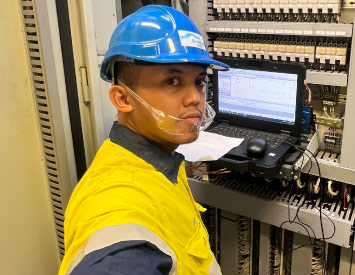
As industries move toward Industry 4.0 and smart manufacturing, Kent is eager to apply these emerging technologies in his work.
“By leveraging AI and data science, we can predict maintenance needs, optimize energy consumption, and automate decision-making in complex environments,” he said. He sees these advancements as essential for the future of process control systems.
For professionals considering pursuing a Master’s degree in this area, Kent’s advice is straightforward. He believes that continuous learning is essential in today’s fast-paced technological landscape.
“Investing in your education is one of the best decisions you can make,” he said. “The program not only builds on your existing experience but also opens new career opportunities and enhances your ability to adapt to emerging industry trends.”
Kent’s journey demonstrates the powerful combination of practical experience and advanced education. Through his studies at EIT, he is enhancing his skills and preparing for the challenges of the future, positioning himself at the forefront of industrial automation.
Are you ready to embark on a similar journey?
Contact Us