HomeNewsQuantum Computing: Engineering the Next Frontier
Quantum Computing: Engineering the Next Frontier
Engineering problems that once took months are being solved in hours, thanks to quantum computing. This is opening doors to another level of innovation, from technology, to energy, and medicine. Read on to see how this could change the way we solve problems, and why it matters for the next generation of innovators.
Quantum computing isn’t just a faster computer; it’s a whole new way of solving engineering problems by harnessing the strange and powerful laws of quantum mechanics. Engineers and technical professionals can now discuss challenges that were once considered impossible. It can cut development time and unlock solutions that ordinary computers can’t reach, from designing advanced materials to simulating entire city infrastructures.
In this article, we’ll see how quantum computing works, its applications across engineering fields, the challenges engineers and technical professionals face, and the exciting possibilities it opens for the future.
How Quantum Computing Works
Quantum computing might sound intimidating, but the core idea is simple. Think of it like trying to find your way through a maze. A regular computer uses bits that are either 0 or 1. It’s like having a single person walking through the maze alone, testing one path at a time, which could usually take months or years to finish. Quantum computers, in this case, use qubits which can be either 0, 1, or both at the same time. It’s like having thousands of versions of that single person exploring through the maze all at once, where they can share instant information about which routes to take through a process called superposition, and can also be able to communicate well with each other through a process called entanglement. With this, a quantum computer can find the fastest maze route in an instant, thus solving problems that a normal computer would usually take years to figure out. It’s like turning a one-man task into a massive team adventure that is solving problems all at once.
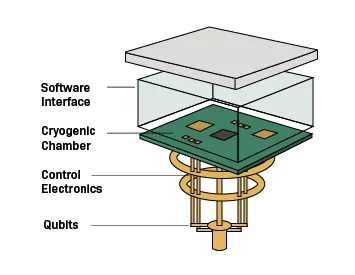
Diagram of a Quantum Computer
Quantum in Action
Quantum computing is set to transform multiple engineering disciplines:
Materials Engineering: Quantum simulations enable the modeling of atomic-level interactions to design stronger, lighter, and more durable materials. Aerospace engineers, for example, could develop advanced composites or materials that combine strength and durability in ways that single materials alone cannot, for aircraft that improve fuel efficiency while maintaining structural integrity, cutting development time and cost.
Energy and Power Systems: Quantum computing allows engineers to simulate energy flow at different scales. This can predict failures and accelerate the development of renewable energy systems.
Civil and Structural Engineering: Quantum computing allows for detailed simulations that can anticipate stress and improve resilience to natural events like earthquakes.
Artificial Intelligence and Machine Learning: Quantum computing can supercharge AI applications by training models and solving problems much faster than regular computers struggle with. It can make AI and machine learning 100 times more powerful than regular computers.
Engineering Hurdles
While quantum computing holds immense promise, engineers face several practical hurdles that must be overcome before its full potential can be realized.
Fragile Qubits: Qubits are highly sensitive to temperature, vibrations, and electromagnetic interference because their quantum states rely on a delicate balance in superpositions and entanglements. It’s like their states are being held in a soap bubble that is holding their shape, and the slightest temperature change can disturb them, thus making them quite difficult to maintain.
Scaling Challenges: Building larger quantum processors while keeping them reliable adds another layer of complexity.
Algorithm Complexity: Designing efficient quantum algorithms requires deep expertise in physics, computer science, and engineering, making development demanding.
High Infrastructure Costs: Cryogenic systems, precision fabrication, and specialized hardware remain expensive, limiting accessibility.
To tackle these hurdles, engineers are exploring innovative solutions:
Cloud-Based Quantum Computing: Remote access to quantum processors reduces reliance on fragile on-site hardware.
Hybrid Classical Quantum Systems: Combining standard computers with quantum processors allows practical problem-solving while leveraging quantum advantages.
Advanced Error-Correction Techniques: New methods to help stabilize qubits and improve computation accuracy are emerging.
Gradual Integration: By slowly incorporating quantum processors into existing workflows, organizations can start realizing benefits without relying fully on large-scale hardware.
Stepping onto the Quantum Leap
The future of quantum engineering will be shaped by the widespread use of quantum computers, and the experience gleaned from this. Using stable qubits engineers will complete tasks more efficiently, and as quantum computing becomes more practical and accessible, it will enable them to tackle engineering projects that were previously impossible.
The time to embrace quantum computing is now. As engineers and technical professionals, diving and adapting into this technology today gives you critical insights into how this breakthrough can directly shape your projects, accelerate your career, and keep you ahead in a rapidly evolving engineering field.
This article was published January 27th, 2026 and the content is current as at the date of publication.