HomeNewsModular and Prefabricated Solutions for Resource-Efficient Construction
Modular and Prefabricated Solutions for Resource-Efficient Construction
Today’s next-generation engineering, coupled with the shift toward low-carbon material selection, is transforming the way we build. Within this evolving landscape, modular and prefabricated systems are emerging as key approaches that enable faster delivery and reduced environmental impact in modern construction.
This article explores modular and prefabricated construction and how these methods shift the building process from traditional on-site techniques to a more controlled off-site production. It also discusses what sets modular systems apart from prefabrication and why off-site construction is becoming a core strategy for a more resource-efficient development.
From Site-Built to System-Built
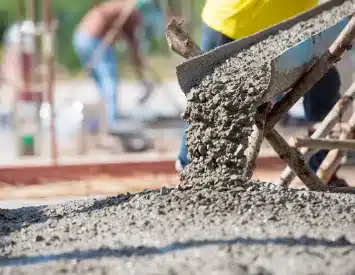
Traditional construction follows a site-based approach in which materials are delivered, stored, cut, assembled, and installed directly on-site. Work progresses sequentially, with different trades arriving at various stages that rely on on-site coordination and manpower to align structural, mechanical, and finishing works. While being widely used, this method is often prone to weather delays, material inefficiencies, and inconsistent workmanship, which can lead to extended project timelines. The demands for faster delivery, higher material quality, and the growing focus on using low carbon materials eventually drove a shift toward using more optimized methods of construction.
Conventional concrete pouring
Off-Site Systems Defined
As construction progresses toward a controlled and efficient process, modular and prefabrication methods have taken on a central role. While they both share a common foundation, they differ in the extent of off-site completion and the level of integration achieved before reaching the construction project site.
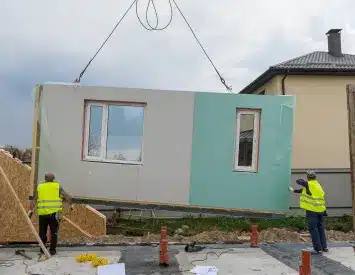
Modular construction assembly
Prefabrication focuses on the off-site production of individual building components in a controlled factory environment. In this setup, structural and non-structural elements such as precast concrete panels, steel beams, curtain wall systems, and façade assemblies are produced in high precision using standardized processes and advanced machinery. They are designed as parts of a system and require on-site assembly to form walls, floors, and structural elements.
In some advanced cases, these components are made to connect more efficiently, but they are still only partial elements of the building. As a result, this approach improves material efficiency, quality control, and production consistency.
Modular construction, on the other hand, takes a more integrated approach by producing entire sections of a building as complete, self-contained units called modules. Instead of assembling individual components on-site, each module is fully constructed in the factory as a complete building segment, such as a room, a portion of a floor, or an entire structural element. Within the factory, structural systems are constructed first, followed by walls, floors, and partitions, along with the installation of mechanical, electrical, and plumbing systems. In many cases, interior finishes are completed before the module leaves the factory, making it nearly ready for use upon arrival. Once transported to the site, these modules are lifted and connected to one another, forming the final building with minimal additional work compared to prefabrication.
Advancing Efficiency in Modern Construction
As the modern construction industry continues to align with sustainability goals, resource-conscious and environmentally responsible methods are becoming increasingly important. Modular and prefabricated construction stand out as key approaches that not only improve efficiency but also directly support sustainable building practices.
Below are the key drivers that make these systems impactful in reducing environmental impact and optimizing resource use:
Sustainability Through Material Efficiency – Reducing material waste and using resources efficiently is essential in lowering the environmental impact of construction. Prefabrication is often used in precast concrete façade systems for high-rise buildings, where low carbon material components are cast with exact measurements; while modular construction is often applied in volumetric residential projects where light-gauge timber or steel modules are factory-built and assembled on-site.
Convenience – Minimizing on-site disruption is important for maintaining safety in surrounding site conditions. Prefabrication achieves this by limiting on-site activities, as most components are ready for installation; while modular construction further reduces disruption by delivering fully completed units that only require placement and connection.
Quality Control and Precision – Maintaining high quality and precision is essential to ensure safety and long-term performance in construction. Prefabrication achieves this through automated measurement systems that ensure tight dimensional tolerances and consistent finishes, while modular construction delivers fully assembled volumetric units built under factory-controlled conditions.
Economic Efficiency – Cost-effectiveness is essential in making construction projects convenient and reliable. Prefabrication reduces project costs through techniques like automated cutting and CNC fabrication of steel components; whereas modular construction uses 3D module integration in assembly-line production of volumetric units that reduces on-site labor and shorten construction timelines.
Building Forward
With these advancements transforming modern construction, modular and prefabricated systems are being increasingly applied across various engineering and construction sectors. Engineers are increasingly adopting these methods to gain better control over design, improve precision in execution, advance sustainability, and reduce uncertainties that often arise in traditional site-based construction. At the same time, customers and end-users prefer these systems for their faster delivery, consistent quality, and economic advantages by reducing labor costs and minimizing project delays. Their ability to improve coordination and enhance overall building performance highlights the change toward more controlled and predictable methods.