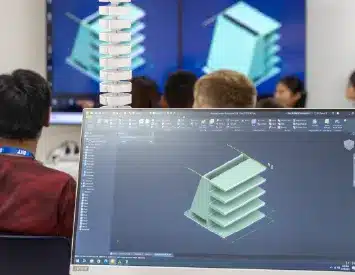
Today’s manufacturing world reimagines the workshops of the past by combining the bespoke craftsmanship of the artisan with the high-speed precision of autonomous robotics. Skilled machinists once relied on blueprints and years of experience crafting each part by hand. Nowadays, CAD designs, CAM simulations, and CNC machines work together to bring ideas to life with precision and speed.
This article explores the workshops of the past to today’s intelligent, digitally driven production systems, and explains how CAD, CAM, and CNC work together to shape the future of manufacturing.
From Craft To Code
In the early industrial era, skilled operators transformed raw materials using mechanical tools and paper blueprints. The major advantage of this approach was the high level of human craftsmanship where each part reflects the worker’s expertise that allows them to anticipate issues, make corrections on the spot, and devise solutions. However, this method also had notable disadvantages. Mistakes were inevitable, often resulting in costly rework, while repeated machine adjustments slowed production. Achieving consistent results across multiple parts was challenging, particularly complex assemblies that were difficult to execute manually.
As technology advanced over time, the limitations of traditional manufacturing became increasingly apparent. Digital manufacturing introduced Computer-Aided Design (CAD) software programs such as AutoCad for 2D and 3D drafting and SolidWorks for parametric mechanical design and product development. Along with this is the development of Computer-Aided Manufacturing (CAM) software packages such as Mastercam that converts the 2D and 3D CAD models for multi-axis machining and Fusion 360 CAM that integrates designs and simulates detailed manufacturing operations. Such programs improve collaboration and time management, as multiple engineers can work on the same model simultaneously. It also allows them to test, optimize, and ensure precision and accuracy. In short, CAD goes first in creating designs digitally, CAM follows in producing detailed manufacturing outlines, before setting the stage for the final step which is CNC machining.
The Role of CNC
CNC (Computer Numerical Control) machining is the point where designs from CAD and outlines from CAM are being transformed into tangible components. High-end CNC machines execute through micron-level accuracy using its standard geometric code that consists of commands on how to move, at what speed, and along which path. Through this, CNC machines guide tools with utmost precision. Engineers rely on it because of its ability to handle complex geometries and maintain consistency across multiple parts. It also reduces human error and minimizes material waste, enabling continuous production whether for a single prototype or full-scale manufacturing.
CNC At Work
CNC machining has transformed how engineers approach manufacturing across industries. Some notable applications include:
- Biomedical Engineering – in creating prosthetics and implants and enables the production of custom devices to patients.
- Industrial Automation – in producing gears, engine blocks, and other mechanical and transmission components that require repeatability and high durability for industrial applications.
- Electronics and Robotics Engineering – in fabricating small-scale mechanical parts for electronic devices such as drones and robots.
- Mechanical Engineering – in developing aerospace components (turbine blades, brackets)
Hands-On CNC at EIT
At the Engineering Institute of Technology (EIT), CNC machining is a hands-on learning experience that bridges digital design and real-world production. Students and researchers gain access to a state-of-the-art CNC machine that enables them to turn models and plans into precise, tangible components. This practical exposure allows learners to experience the full workflow of modern manufacturing.
EIT’s CNC machine facilities also support multi-axis milling and precision drilling wherein students not only learn to operate but also gain skills in material handling and quality assurance. It also empowers research and prototyping giving learners the chance to tackle complex engineering challenges.
EIT equips its students with the practical skills and innovation mindset needed to excel in modern manufacturing environments. It’s a space where digital designs truly come to life that prepares students to meet industry demands with precision and creativity.
References
From CAD to CNC: How CAD/CAM Integration Streamlines Precision Machining
This article was published March 10th, 2026 and the content is current as at the date of publication.