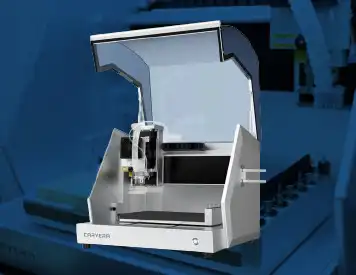
The Engineering Institute of Technology (EIT) has taken a major step towards hands-on engineering education, opening doors to real-world manufacturing processes with the arrival of its newest Mechanical Engineering laboratory asset: a desktop computer pneumatic control (CNC) machine.
For students, this state-of-the-art equipment brings theory into practice.
Rather than simply studying machining concepts, they are now able to experience everything firsthand. They can see, shape, and hold design parts, set parameters, learn how materials behave under cutting forces, and observe how tool paths affect quality, all while operating the same technology used in today’s advanced production.
The backbone of modern machinery, CNCs help accurately produce high precision parts and components for various industries like agriculture, automotive, aerospace, medical, defense, energy, jewelry, cabinetry, and much more. Depending on the complexity of the requirement, these machines usually operate on three or four axes, preset by manufacturers to a neutral home position.
Precision, automation, and industry-standard features
EIT’s CNC has three axes that allow students to machine wood, aluminum, epoxy, polymers, and other materials with speed and precision. The worktable (Axis 1) secures the material, while the tool changer and cutting head (Axes 2 and 3) handle the machining process.
Students can experiment with six interchangeable cutting tools, automatically selected based on parameters set in the computer software. Instead of walking through every internal step, they see the system confirm tool changes, measure tool height, and resume machining, all represented by G-codes and M-codes.
These features help them understand not only what the machine does but also why each action matters for quality and efficiency.
Safety and innovation combined for optimal learning
Beyond precision and automation, EIT’s CNC embodies innovation in safety and design with several built-in protections that reflect industry best practices.
The system replaces traditional lubricants with compressed air tubing to help prevent overheating and keep the workspace clear. Chips and dust are drawn into a collection container, creating a cleaner environment, and reducing time spent on manual cleanup.
It only runs when fully closed, stopping immediately when opened. This allows students to just focus and not think of machine or self-damage, supporting a safe learning experience that’s ideal for repeated hands-on practice.
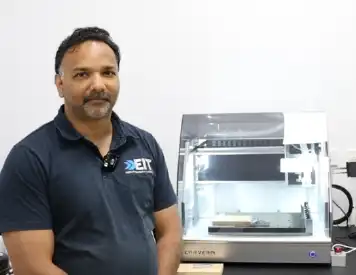
The introduction of the CNC into the Mechanical Engineering Lab is more than just an equipment upgrade; it expands what students can do, make, and learn.
Preparing the next generation of engineers
By practicing digital manufacturing from start to finish, students develop technical fluency that carries into industry. They build skills in automation, toolpath planning, material selection, and process optimization. Most importantly, they leave with pride and confidence knowing how to create real components with real equipment.
As precision automation continues to shape global industries, EIT ensures its graduates are ready to contribute from day one, designing smarter, machining faster, and solving more complex problems with both creativity and technical depth.
Watch the CNC in use in one of our labs below.