Artificial Intelligence (AI), often called the “fourth industrial revolution,” has transcended the boundaries of science fiction to become a driving force behind engineering innovation, efficiency, and wide field of study opportunities. We highlight key points from a recent webinar and underscore AI’s pivotal role in reshaping the engineering landscape.
In a dynamic world where technology takes center stage, the Engineering Institute of Technology (EIT) hosted a groundbreaking webinar in August. This event, led by EIT’s Dean of Engineering, Dr. Steve Mackay, brought together experts, practitioners, and enthusiasts to explore the profound impact of AI on the engineering domain.
The webinar spotlighted how AI steadily becomes indispensable, ushering in transformative changes across diverse engineering disciplines. One of the primary areas Dr. Mackay underscored was AI’s ability to automate repetitive tasks, thereby liberating engineers to concentrate on more creative and strategic facets of their work.
Machine learning algorithms powered by AI are adept at analyzing vast datasets and generating insights that would have taken human engineers an inordinate amount of time to produce. This newfound efficiency is propelling engineering projects forward at an unprecedented pace.
“AI has been a particularly interesting area for the last three years now. It’s certainly grown dramatically … as I’m speaking to you, there will be new developments occurring,” Dr. Mackay noted in his webinar.
Additionally, the integration of AI has unveiled a new era of predictive maintenance, with machines equipped to detect anomalies and potential failures before they occur. This reduces costs and significantly enhances safety protocols, a paramount concern in the engineering field.
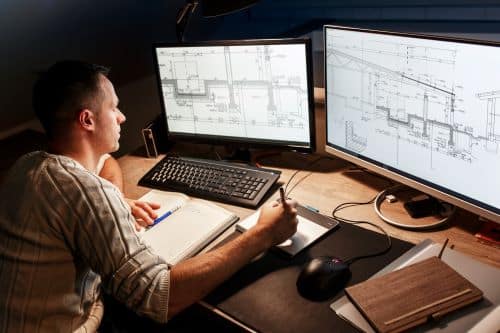
Transforming Construction With AI
The construction industry is undergoing a remarkable transformation thanks to the advent of AI. This disruptive technology brings forth a wealth of possibilities that have the potential to revolutionize various facets of construction, leading to unprecedented levels of innovation, efficiency, and productivity.
Globally renowned organizations have recognized the transformative power of AI, offering compelling statistics that underscore its vast potential.
According to a comprehensive report by McKinsey, “Artificial Intelligence: Construction Technology’s Next Frontier,” adopting AI in construction can generate an astonishing USD 1.6 trillion (approximately AUD 2.6 trillion) in value globally.
This staggering figure is a testament to the profound economic impact that AI could bring to the industry. Furthermore, the World Economic Forum estimates that AI technologies could contribute up to a staggering USD 13 trillion (approximately AUD 20.5 trillion) to the global economy by 2030, with the construction sector being one of the key beneficiaries.
The impact of AI extends far beyond economics and delves into productivity as well. A study by Oxford Economics revealed that implementing AI in construction could potentially increase productivity by an impressive 40%. This boost in productivity translates into shorter project timelines, reduced costs, and overall improvements in project delivery, heralding a new era of construction efficiency.
Moreover, AI-driven solutions within construction have the potential to enhance safety significantly. As cited by America’s National Safety Council, AI-powered technologies can reduce construction accidents by an encouraging 20%. Using AI for real-time monitoring, predictive analytics, and risk assessment, construction companies can take proactive measures to identify potential hazards and prevent accidents before they occur, fostering a safer work environment.
Infinite Possibilities
The boundless potential of AI in construction is continually evolving.
From optimizing project planning and design to automating repetitive tasks and predictive maintenance, AI is poised to revolutionize the construction industry, driving efficiency, cost savings, and improved project outcomes.
By harnessing the power of AI, construction companies can embrace a new era of unprecedented possibilities, propelling the industry toward greater productivity and success. There are various ways that AI could bolster the various phases of construction. We look at just two: design and smart construction.