HomeNewsBreaking Sustainability Misconceptions and Building Practical Solutions
Breaking Sustainability Misconceptions and Building Practical Solutions
Sustainability has become a defining focus across industries, from energy and mining to manufacturing and infrastructure. Yet, despite its growing importance, it’s often misunderstood.
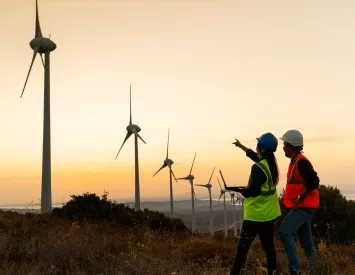
Engineering professionals at a wind farm
Misconceptions around what sustainability really means, and how it’s applied in practice, can slow progress and create confusion, particularly for engineers and technical professionals who are expected to drive meaningful, measurable change. When sustainability is misunderstood, it often leads to missed opportunities, inefficient solutions, or resistance to innovation within organisations.
Building a clear, practical understanding is therefore essential for translating sustainability from a buzzword into actionable strategies that deliver both environmental and economic value.
Below are some of the most common sustainability myths, and what they actually mean in today’s engineering landscape.
Sustainability is only about the environment
One of the biggest misconceptions is that sustainability is purely environmental. While reducing emissions and protecting natural resources are key elements, true sustainability rests on three pillars: environmental, economic, and social.
For engineering professionals, this means designing systems that are not only energy-efficient, but also cost-effective and socially responsible. Whether it’s ensuring reliable power in remote communities or improving safety in industrial operations, sustainability is about long-term value, not just environmental impact.
Sustainability is too expensive
There’s a persistent belief that sustainable solutions are always more costly. While some technologies may require higher upfront investment, they often lead to significant long-term savings through improved efficiency, reduced waste, and lower operational costs.
For example, integrating renewable energy systems or improving process efficiency in manufacturing can reduce both emissions and expenses over time.
Small changes don’t make a difference
Many assume that only large-scale projects can drive meaningful impact. In reality, incremental improvements, such as optimizing energy usage, upgrading equipment, or improving system design can collectively lead to substantial gains.
Sustainability is not relevant to all industries
Another common myth is that sustainability only applies to sectors like renewable energy. In truth, every industry has a role to play. Mining, oil and gas, manufacturing, and transport are all undergoing major shifts toward more sustainable practices.
This creates a growing demand for engineering professionals who understand how to integrate sustainability into traditional systems, whether through cleaner technologies, improved efficiency, or innovative design approaches.
Sustainability is a trend, not a necessity
Some people think that sustainability is just a passing trend or a marketing buzzword. However, global regulations, investor expectations, and evolving industry demands are rapidly positioning it as a core requirement for future operations rather than a temporary focus.
Organizations are under increasing pressure to reduce their environmental footprint, improve transparency, and operate more responsibly across their entire value chain. This shift is driven not only by compliance but also by the need to remain competitive and resilient in a changing global landscape.
As a result, sustainability is no longer optional, it’s a critical component of modern engineering.
Engineering professional assessing renewable energy levels
Bridging the gap through education
Understanding sustainability in a practical, engineering-focused context is essential to overcoming these misconceptions. This is where institutions like the Engineering Institute of Technology (EIT) play a vital role.
EIT’s courses are designed with industry in mind, equipping engineers with the skills needed to apply sustainable principles in real-world scenarios. From renewable energy integration and energy efficiency to emerging technologies like hydrogen systems and carbon capture, the focus is on practical knowledge that can be implemented immediately.
By aligning education with current industry demands, EIT helps engineering professionals move beyond theory and contribute meaningfully to sustainable development across sectors.
“What you do makes a difference, and you have to decide what kind of difference you want to make.” – Jane Goodall