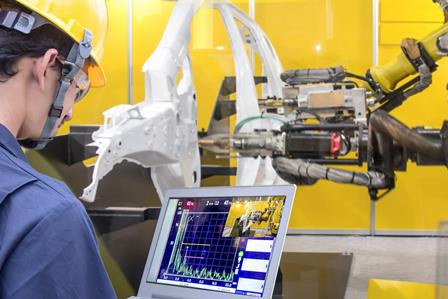
The rapid growth of new industries and technologies has led to a global shortage of skilled automation, instrumentation, and control engineers. The objective of this master’s program is to equip engineering professionals with expertise in Industrial Automation, meeting the increasing demands of industry, including control, instrumentation, communication, machine learning and safety.
The Master’s program is designed to equip students with essential skills for the automation sector, integrating twelve core modules and a project thesis. Targeted at professionals with backgrounds in fields like electrical, electronics, and mechanical engineering, the curriculum includes key subjects such as Power Engineering, Programmable Logic Controllers, and Industrial Process Control Systems, laying a robust foundation in both theory and application.
Graduates of this program will be able to:
This course is internationally recognized under the Washington Accord.
The Master of Engineering (Industrial Automation) is a comprehensive two-year program, full time or part time equivalent, along with a variety of elective options, each dedicated to crucial aspects of Industrial Automation engineering.
Industrial Automation Introduction provides the essential foundations required in the automation field. Power Engineering explores the key equipment and technologies involved in power systems, including power generation, transmission, and distribution networks. Programmable Logic Controllers examine the operating principles of programmable controllers, networking structures, distributed controllers, and program control strategies. Industrial Process Control Systems combines process identification with feedback control design, alongside the hardware, architectures, and software methods used to develop and implement complex control solutions. Industrial Instrumentation focuses on widely used measurement techniques, transducers, and microprocessor-based devices that enable reliable industrial instruments. Industrial Data Communications delivers the knowledge required to manage modern field buses and industrial wireless systems. Safety Instrumented Systems introduce hazard identification, risk management, and risk-based protection design within functional safety frameworks. SCADA and DCS address the architecture, evaluation, and configuration of supervisory control and distributed control systems. Finally, Advanced Process Control and Machine Learning for Industrial Automation explore advanced algorithms, intelligent control concepts, and their applications in modern automation environments.
The Project Thesis, as the capstone of the course, requires a high level of personal autonomy and accountability, and reinforces the knowledge and skill base developed in the preceding subjects. As a significant research component of the course, this project will facilitate research, critical evaluation and the application of knowledge and skills with creativity and initiative, enabling students to critique current professional practice in the Industrial Automation industry.
The program is composed of 13 units. These units cover a range of aspects to provide you with maximum practical coverage in the field of Industrial Automation Engineering.
Please refer to the current teach-out program structure here.
Note: units may be completed in a different order depending on individual circumstances, pre-requisites and unit availability.
Year One |
||||
| Term | Unit Code | Unit Name | Duration (weeks) | Credit Points |
| Term 1 | MIA500A | Industrial Automation Introduction | 12 | 3 |
| MIA502A | Programmable Logic Controllers | 12 | 3 | |
| Term 2 | MIA503A | Industrial Process Control Systems | 12 | 3 |
| MIA504A | Industrial Instrumentation | 12 | 3 | |
| Term 3 | MIA509A | Electrical Engineering for Industrial Automation | 12 | 3 |
| MXX507 | Professional Engineering Management | 12 | 3 | |
| Term 4 | MIA508A | Safety Instrumented Systems | 12 | 3 |
| MIA510A | Industrial Data Communications | 12 | 3 | |
Year Two |
||||
| Term 1 | Elective 1* | Choose any 1 from the following list below | 12 | 3 |
| MIA602A | SCADA and Distributed Control Systems | 12 | 3 | |
| Term 2 | Elective 2* | Choose any 1 from the following list below | 12 | 3 |
| MXX601 | Engineering Practice and Key Research Methods | 12 | 3 | |
| Terms 3/4 | ME700 | Project Thesis | 12 | 12 |
*Pool of Elective Units |
||||
| MIA605A | Machine Learning for Industrial Automation | 12 | 3 | |
| MIA603A | Advanced Process Control | 12 | 3 | |
| MME602A | Computer Aided Design and Manufacturing | 12 | 3 | |
| MME505A | Process Engineering | 12 | 3 | |
| MME606A | Data Analytics for Engineering Applications | 12 | 3 | |
| MEE606 | Substation Design and Automation | 12 | 3 | |
Additional Mandatory Units |
||||
| BXX001-004 | Hands-on Workshops 1 Hands-on Workshops 2 Hands-on Workshops 3 Hands-on Workshops 4 |
1 | 0 | |
| MXX001 | Professional Practice Hands-on Workshop | 1 | 0 | |
| MXX510 | Professional Experience | 1 | 0 | |
To gain entry into this program, we require applicants to hold:
* With integrated compulsory twelve-week professional industry experience, training or project work of which six weeks are directly supervised by a professional/eligible professional engineer as determined by EIT.
** All applicants must have evidence of automation and/or electrical exposure at undergraduate level and/or work experience. Congruent field of practice means one of the following with adequate Industrial Automation Engineering content including fundamentals of Programming, Control and Instrumentation (fields not listed below to be considered by the Dean and the Admissions Committee on a case-by-case basis):
Please note: meeting the minimum admission criteria does not guarantee entry to our programs. Applications are assessed on a case-by-case basis.
Please check the Documentation Guidelines for your application.

(Deputy- Vishal Sharma)
Our courses are delivered by experienced engineers and technical experts from around the world. Many have tackled real-world engineering challenges and bring practical, applied knowledge directly into the classroom.
We draw from a global pool of instructors and lecturers across our organisation. Explore our full team of expert educators on the Instructors & Lecturers page here.
Please note: Not all lecturers and instructors listed on this page will teach every course. The team teaching your course will be confirmed as part of your course enrolment.
For full current fees in your country go to the drop down filter at the top of this page or visit the Fees page.
Payment Methods
Learn more about payment methods, including payment terms & conditions and additional non-tuition fees.
Like all Australian higher education providers and universities, EIT programs are accredited by the exacting standards of the Australian Government’s Tertiary Education Quality and Standards Agency (TEQSA).
This online master’s degree is fully accredited by Engineers Australia under the Washington Accord. It is internationally recognized through the International Engineering Alliance (IEA) and its signatory countries, ensuring global recognition of the qualification and alignment with international engineering education standards.
Find out more about country-specific accreditation and professional recognition.
This course is classified as Level 9 under the Australian Qualifications Framework (AQF).
This course may use the following software:
Due to ongoing unit and course reviews, software may change from the list provided. Learn more about the Practical Learning at EIT here
Potential job roles include engineering and management positions in the following areas of expertise:
Our Master’s degrees take 2 years to complete full-time and are delivered over 4 terms per year, each of 12 weeks. Students are expected to spend approximately 10 hours per unit, per week learning the program material, completing assessments and attending tutorials. After enrolment the maximum time allowed to complete all units is 5 years.
Application Deadline:
You must submit your application at least four weeks before the start date to be considered for your desired intake.
Census Date:
A census date is the date at which an enrolment is considered to be final. Any withdrawal you make after the study period census date will incur an academic penalty (for example, a fail grade) and a financial penalty (for example, no refund of your student contribution or tuition fees). See our current census dates.
Any student has a right to appeal a decision of the Engineering Institute of Technology (EIT) or any member of the institute’s staff. EIT has a comprehensive Policy on Appeals and Grievances to assist students.

Learn more about the Master of Science in Industrial Automation and Instrumentation Control via our affiliated institute.
Learn More