What if materials could think, heal, and adapt on their own? From self-repairing concrete to shape-shifting alloys, smart materials are redefining what’s possible in engineering, and professionals across the industry can’t stop talking about what’s coming next.
Why Smart Materials are Creating a Buzz
For most engineers and technical professionals, discovering smart materials is like looking into a whole new toolbox because they offer capabilities that traditional materials simply don’t have. Unlike steel, concrete or regular plastics, materials can respond to their surroundings and even fix themselves. This means designers can solve problems in ways that used to seem impossible-like bridges that adjust during an earthquake, wearable devices that generate power as you move, or medical implants that fit perfectly to a patient’s body.
Another good thing about this is that smart materials bring people from different engineering and technological fields together, and this hybrid form of collaboration sparks even more creativity and innovation. Let’s take a close look at some of these exciting innovations.
Shape Memory Alloys
Ever encountered a material that could fix itself or bounce back to its original form on command? That’s what shape memory alloys (SMAs) do. These are special metals that can deform when triggered by heat or electricity.
How it works:
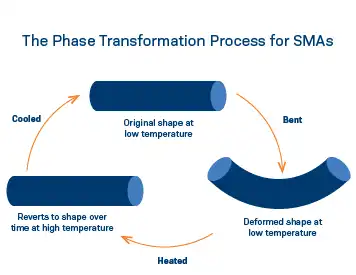
The secret lies in the structure of their crystals. SMAs have two phases: martensite, the flexible part, and austenite, the rigid part. When you bend the metal, it changes to its martensite phase and can easily change shape. But when you apply heat or electric current through it, it switches back to its austenite phase, changing its original shape. This phase change is what gives SMAs their shape memory.
Why it matters:
The adaptability of SMAs make them a useful ingredient in many engineering fields.
Medical engineering: SMAs help medical devices adapt to the human body with ease. Stents and catheters can expand automatically inside blood vessels; orthodontic wires gently move teeth into place, and surgical instruments can provide doctors with additional precision and control by adjusting their shape during procedures.
Aerospace engineering: SMA’s are being used in deployable antennas and other satellite components that unfold automatically in space as well as in morphing aircraft wings to improve lift and adjust at high speeds.
Robotics: SMA’s are being used in adaptive prosthetics that respond to human movements; in robotic arms and grippers that return without motors, and in micro-actuators for small-scale devices.
Civil Engineering: SMAs are used in earthquake-resistant bridge components like smart fasteners and joints that adapt under stress and absorb shock that later return to shape.
Self-Healing Polymers
Ever encountered a material that can repair itself after being damaged? That’s the idea behind self-healing polymers. Instead of ending a product’s life through cracks and wear, these materials can recover on their own, extending durability.
How it works:
Self-healing polymers usually work in two forms; for some, tiny capsules with a healing liquid are built into the material so that when a crack forms, these capsules break open, and the liquid flows into the cracks and fills the gap thus sealing the damage. In other types, the polymer molecules are designed to reconnect naturally. In this case when the material is damaged, the broken molecular bonds slowly move back together, and reform usually when triggered by heat, light, or pressure. No matter the method, the goal is the same-stop small cracks from spreading and extending material life.
Why it matters:
Damage and wear are inevitable in engineering, that’s why self-healing polymers reduce the need for constant maintenance and they improve safety.
Civil engineering: Can typically be applied in protective coatings for buildings and pipelines as well as in concrete additives that seal cracks before they spread.
Electronics engineering: Generally, they appear in flexible screens, and protective casings that recover from minor impacts.
Biomedical Engineering: These are being tested in implants and medical coatings to reduce risk of failure inside the human body.
Aerospace and Energy Engineering: these are used in protective aircraft coatings that could repair micro-cracks caused by vibration and pressure changes; in battery casings and insulation materials that help seal cracks that could lead to major leaks and energy loss.
Piezoelectric Materials

Ever thought that simple movement could generate electricity? That’s what piezoelectric materials do. They can convert mechanical energy into electrical energy, and in some cases, vice versa.
How it works:
Piezoelectric materials are special because of how their tiny crystals are uniquely arranged inside. When a mechanical force is being applied, the crystals shift slightly, thus creating an electrical charge. When electricity is applied as well, the material changes shape, and this two-way behavior allows this material to act as both sensors and actuators.
Why it matters:
Piezoelectrical materials make it possible to capture energy that would otherwise be wasted, such as footsteps, vibrations, or sounds.
Medical engineering: Typically used in ultrasound imaging devices and precision surgical tools.
Automotive engineering: used in sensors to monitor car engine performance and improve safety systems like airbag deployment.
Industrial and civil engineering: used in vibration sensors to monitor machine health; smart floors in some cities also use piezoelectric plates that are placed under walkways to capture mechanical energy from footsteps, thus producing electricity used to power lights.
Thermochromic and Photochromic Materials
Ever used sunglasses that darken when you step into sunlight? Or use a mug that changes color when it’s filled with hot coffee? That’s photochromic and thermochromic materials at work. Thermochromic materials change color when temperature shifts, while photochromic materials change when being hit by sunlight, particularly UV rays.
How it works:
The molecules inside thermochromic materials contain special liquid crystals that twist and turn depending on heat, and these twists reflect different wavelengths of light, so the color you see changes. Whereas the molecules in photochromic materials react to the bonds of UV light particles and form a new structure that absorbs visible light differently, so the material appears darker when exposed then goes back to normal when the light fades.

Why it matters:
Medical engineering: Usually used in lenses for eyewear or goggles that automatically darken when outdoors
Materials and civil engineering: Used in surface coatings that indicate UV exposure for sensors and safety equipment; coatings for windows in buildings to reduce heat and improve energy efficiency
Automotive engineering: applied in car windshields and sunroofs that adjust transparency to sunlight
Magnetorheological Fluids
Ever wished a material could instantly change its stiffness at the flip of a switch? That’s what magnetorheological fluids do. These are special liquids that can go from free flowing to almost solid in milliseconds when exposed to a magnetic field.
How it works:
There are tiny iron particles inside a magnetorheological fluid that float freely within liquid in a normal state. But when it is exposed to a certain magnetic field, these particles form chains that become stronger, thus blocking the liquid from moving easily, making the fluid thicker and almost solid.
Why it matters:

Automotive engineering: this material is being applied in adaptive shock absorbers and suspension systems to adjust stiffness and adapt to bumps and turns, thus providing a smoother ride.
Industrial engineering: Used in heavy equipment to reduce unwanted vibrations and improve performance.
Civil & Structural engineering: usually installed in buildings to absorb seismic vibrations to protect the structure and its occupants.
Aerospace engineering: used in adaptive control surfaces to help aircrafts respond to changing forces and improve performance
From Tools to Partners
For engineers and technical professionals, these materials are more than tools; they are considered partners in creating a smarter and more responsive future. From metals that remember their shape to liquids that stiffen on command, these materials respond and open possibilities we once thought impossible. Beyond their technical power, they inspire collaboration, helping shape a smarter, more responsive future.
This article was published January 27th, 2026 and the content is current as at the date of publication.
Back to news